Game Summary
Immortals of Aveum is a single-player, first-person magic shooter released on August 22nd, 2023 for PC, PlayStation 5, and Xbox Series X/S.
It tells the story of Jak as he joins an elite order of battlemages to save a world on the edge of abyss. With legions of soldiers on both sides of the Everwar, he must uncover the mysteries of Aveum’s troubled past, if there’s any hope for saving its future. Master three forces of magic and unleash spells with deadly skill in a game that defies FPS conventions.
Game Features
Be the Battlemage: Join the order of Immortals, the champion protectors of Lucium, and become Jak, an elite Triarch Magnus.
Master Your Magic: Fast, fluid, first-person spell-based combat that’s easy to learn and satisfying to master, where players are rewarded for clever chained attacks and well-timed counters.
Unleash Your Arsenal of Spells: Unlock and upgrade more than 25 spells and 80 talents. Discover, upgrade, and craft hundreds of pieces of magical gear to synergize your playstyle across all three forces of magic.
Save a World on the Edge of Abyss: Jak and Lucium’s elite Immortals must race to uncover the mysteries of Aveum’s past, if there’s any hope of savings its future.
My Work – Summary
- Employed as a Lead Level Designer for ~ 3 years, from start (just before entering production) to finish.
- Employed as a Senior Level Designer for ~ 1 year prior during pre-production.
- Hired and managed the Level Design team, which reached 14 remote Level Designers at its peak.
- Provided leadership and direction on 18 narrative-driven levels, 3 hub levels, & 30 challenge levels.
- Did extensive hands-on level design work on 2 narrative-driven levels, 3 hub levels, & 1 challenge level.
- Handled a variety of smaller tasks on pretty much every level – whatever needed extra support.
- Wore many hats (tight deadline, large-ish scope, small systems & narrative team).
- Ensured content was delivered on time and to quality with minimal bugs.
My Lead Work – Highlights
Beyond the high-level summary of my lead work (mentioned above) and the normal day-to-day of a lead, here are a handful of things I did as Lead Level Designer that I’m proud of.
Shipped a narrative-driven, single-player, new IP game from start to finish as a first-time lead while managing a remote team of 14 level designers across 4 different time zones during a pandemic amidst adjusting to life as a new parent.
- It was a constantly challenging and rewarding experience. Being on the other side of the fence gave me a new perspective and reinvigorated my passion for level design (and my side-passion for organization and order). It leveled up all of my skills and gave me a chance to elevate my team too. In addition to getting a chance to hone my feedback, layout, scripting, and planning skills (among others), I also gained a lot of valuable interpersonal experience leading and managing a large team of level designers. I also got to have bonus difficulty modifiers in the form of learning to do all of this remotely with the background stress of an unprecedented global pandemic and having a new baby. I’m proud of what the team accomplished and it’s a game that I would have wanted to play myself (even if it does have some of the requisite warts of a first game in a new IP).
Helped shepherd 18 narrative-driven levels, 3 hub levels, & 30 challenge levels from start to finish.
- I was able to collaborate with the leadership team and help the individual level designers drive content forward on a large-ish action-adventure title. I’ve got a knack for disambiguating and I was able to put that to good use and gain clarity of direction for myself and my team while satisfying the various stakeholders and making something we could be proud of. I employed a mix of problem-oriented and solution-oriented feedback as necessary to keep the levels on track and to quality. It was also rewarding to be able to draw on a wealth of past experience making similar games and help my team deal with the ins and outs of making and finishing a narrative-driven, single-player AAA game.
Established and documented a detailed level design process from start to finish, for each phase of development, with success criteria and priorities.
- In practice, this was a fairly thorough to-do list that included all level design tasks (more-or-less) needed for each phase of development. It even had success criteria for each task and examples of what was and wasn’t important for that task. This helped me and the team know what needed to get done and what done did and didn’t look like. Production and I then used this as a tool to track the status of a level and evaluate whether the level was really where it needed to be to move on to the next development phase.
Established and documented implementation guidelines and standards for the mundane but necessary work with a focus on providing clarity.
- I put extra effort into eliminating ambiguity about how non-creative tasks (e.g. implementing waypoints or interacts – among other things) should be done. In past roles, I’ve often encountered mundane tasks such as waypoint implementation thrown over the fence with no information about how the task should be done, which can cause a number of problems. I was tenacious about doing this for every non-creative task – of course I didn’t get them all but I got most of them and I think it helped us hit our deadlines in a tight development schedule.
Mentored level designers.
- This industry is full of passionate people, tight deadlines, and lots of pressure. It can be stressful. I really enjoyed the opportunities to help direct reports deal with stressful situations that I myself have dealt with in their shoes and to pass on my experience whether it be creative, technical, or interpersonal.
My Individual Contributor Work – Details
As Lead Level Designer on a new IP-based project with tight deadlines and a fairly big scope, I pitched in and got my hands dirty as needed throughout development. The following is an incomplete but decent accounting of that work.
In “Yltheum,” the third level/mission, Jak (a cadet of The Immortals) fights alongside the Light’s Army to defend the front from an enemy invasion – accompanied by everything from magic missiles to dragons. While doing so, he discovers the presence of a high-ranking enemy Magnus and witnesses them stealing a mysterious magical artifact, which plays a big role in the plot.
The mission features a boss fight with a dragon, lots of spectacle, scripted events, experiential gameplay, a walk and talk with an important NPC, and a bunch of combat – it’s intent being to sell being involved in a big magic-fueled war. It originally had some one-off gameplay moments that helped further support that fantasy but they had to be cut due to scope constraints. It also supports later revisits, which allow for ability-gated puzzles and rewards.
My Responsibilities
- Took the paper design, iterated on it, and drove the level from concept to alpha.
- Scripted combat and non-combat gameplay, events, checkpoints, objectives, waypoints, and VO.
- Created the initial greybox level geometry.
- Collaborated with Level Artists to iterate on the geometry and assemble visual scenes.
- Implemented the path network and some gameplay pickups.

In “The Immortals,” the fifth level/mission, Jak visits the Palathon, the floating headquarters of the titular Immortals where he meets the Immortals and undergoes Selection (the initiation challenge for the group), which is basically a series of challenge rooms set amidst an ethereal and ever-shifting pocket dimension. He emerges victorious and enjoys a too-short celebration with his allies.
The mission features a series of combat and traversal challenge rooms set amidst an ethereal and ever-shifting landscape (think pathways that rotate and move to and fro as you traverse them) and interspersed with narrative-focused vignettes. It ends with a hub space where the player can chat up a bunch of NPCs who are celebrating his induction to the order. The mission contains two main spaces: the headquarters of The Immortals and the challenge rooms, which are essentially separate spaces. The headquarters is revisited by the player often throughout the campaign.
I worked with another Level Designer to design the kit-pieces for the Path portion of the level, which also doubled as the kit for all of the game’s 30 optional challenge rooms. I pushed for the shifting platforms as a way to represent that the Path itself was living entity and was acting against you. The original version of the level focused almost exclusively on combat and traversal but had no real narrative to accompany it – aside from the need to complete selection. I worked with the Lead Writer and Director to come up with a narrative backbone for the level to give it a little more emotion and that’s how the experiential flashback sequences found their way into the level. I also championed the scripted events depicting other candidates moving through the path and seemingly dying in a variety of ways.
My Responsibilities
- Designed and drove the level from pitch to alpha-ish.
- Scripted combat and non-combat gameplay and events for all of the narrative/experiential sections, most of the traversal sections, and a few of the combats. Other designers handled the level intro, the puzzle, and the Path escape sequence.
- Created the initial greybox level geometry for most of the level (aside from for the bits noted above).

The Palathon is a narrative-based hub level (though it later features as a combat-based level). It serves as the headquarters of the Immortals for the first three-quarters of the game. The player returns here often (before and after most missions). As such, it features a ton of cinematics and narrative-based gameplay as well as a few puzzles.
Beyond the layout, one of my big contributions to this space (and in turn Glaivegate, which serves as a new HQ later in the game) was attempting to fill it with optional content – namely in the form of secondary NPCs you can chat up for more info about the world. We had a big HQ but it felt rather empty so I brought the idea of these secondary NPCs up to the Lead Writer and we put some ideas and a pitch together for the Game Director and got them approved. Though we ultimately had to cut about half of them, we still shipped 5 recurring characters that you can have a bunch of different conversations with.
My Responsibilities
- Created the initial greybox level geometry for most of the level.
- Collaborated with Level Artists to iterate on the geometry (up until alpha-ish – the layout changed a bit in places but not drastically for the most part).
- Placement and implementation of idle animations for NPCs (for the multitude of background NPCs and secondary characters that the player could converse with – the primary conversable characters were handled by another designer).
- Optimization of NPC spawning & despawning for the background NPCs.
- First pass on waypoint implementation (this level was one of my test-cases for the waypoint system that I helped design).
- The rest of the substantial work for this level was handled by a series of other Level Designers.

Glaivegate is a narrative-based hub level (though the player first encounters it as a combat-based mission space). It serves as the headquarters of the Immortals for the last quarter of the game. The player returns here several times (before and after missions). As such, it features a number of cinematics and narrative-based gameplay as well as a few puzzles.
My Responsibilities
- Took the initial greybox level geometry for the level and significantly redesigned it with an aim of drastically reducing the size of the space as well as setting it up for a vista reveal when the player first encounters it.
- Placement and implementation of idle animations for NPCs (for the multitude of background NPCs and secondary characters that the player could converse with and some of the primary conversable characters).
- Optimization of NPC spawning & despawning for the background NPCs.
- The rest of the substantial work for this level was handled by another Level Designer.

Lucium is a combat, puzzle, and exploration-based hub level with a few small narrative-based sections. It serves as the initial access point for many of the game’s levels. The player returns here often (before and after missions). There are two small missions that take place within this space in addition to the player needing to travel through different sections of the hub as part of other missions.
One of my big efforts was to drill down into what sort of puzzles we wanted in this and the other hub levels. I took inspiration from recent action adventure titles in designing the crane and elevator puzzles as well as the charge crystal puzzles in Lordsfell to set the direction we wanted to go in.
My Responsibilities
- Took the 2nd pass greybox level geometry for the level and significantly redesigned the first two portions of it (Lordsfell & Greyveil) with an aim of reducing their size and complexity due to time constraints. Performed more moderate reductions for similar reasons to a couple other parts of the map.
- Designed and implemented (first-pass) two of the puzzles for one section of the map (Lordsfell).
- Placement and implementation of idle animations for NPCs (for the multitude of background NPCs in the narrative sections).
- Optimization of NPC spawning & despawning for the background NPCs.
- The rest of the substantial work for this level was handled by other Level Designers.
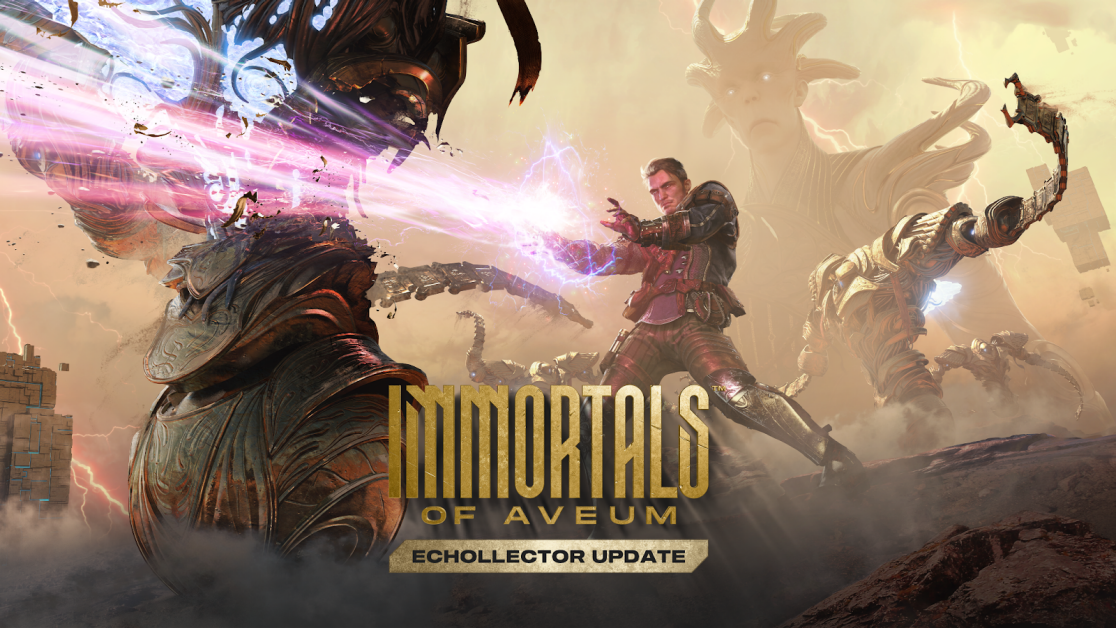
The “Holosteric Fane” is one of the challenge levels for the “Echollector” free DLC, which culminates in a difficult boss fight. This level is an optional and brutally difficult but fair combat setup designed to test players’ late-game skill.
This was supposed to be an easy, low-effort combat challenge room but I couldn’t resist utilizing the moving path aesthetic and working that into the design of the combat. I had the time to spare and I wanted to make this combat feel unique so I put a lot of effort into making a dynamic feeling combat space where the player could have some agency over the encounter’s pacing. I achieved this by bringing in a new, stronger enemy on a moving platform every time you killed an existing enemy. Savvy players could notice this and manage the pace at which they killed existing enemies to give them an edge – or throw caution to the wind and kill everything as quickly as possible, which would lead to greater chaos. Internal playtesting and feedback validated that design so I was pretty pleased with it overall.
My Responsibilities
- Drove level from pitch to gold.
- Scripted combat gameplay, events, checkpoints, and VO.
- Created the initial greybox level geometry.
- Collaborated with Level Artists to iterate on the geometry.
- Implemented and maintained the path network and gameplay pickups.
- Optimized content to meet performance targets and fixed level design-related bugs.
Other Individual Contributor Work
- Collaborated with narrative to drive the inclusion and creation of a cast of secondary characters with whom the player could converse to gain more insight about the lore and world of Aveum.
- Collaborated with narrative to design how conversations and interactions with NPCs worked (not the dialogue selection but rather the types of conversations (one-time convo, repeatable convo, one-liner, etc.) and how the NPCs behaved before and after.
- Collaborated with engineering to design and validate the waypoint system (I drove the adoption of a system that used one shared waypoint graph for both campaign and revisit content).
- Collaborated with engineering to design and validate the savepoint system.
- Collaborated with engineering to design and validate the fast-travel system.
- Designed and prototyped the collectable lore item system.
- Front and back gating implementation for combat spaces in 11 of the campaign levels.
- Assisted with optimization and bug fixing on most levels.
- An enormous amount of smaller, miscellaneous tasks that needed doing and had no one else to do them.
 Shawn Lucas - Level Designer